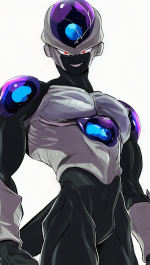
Name: Blyzar
Race: Changeling — Void Clan | Natural Power, Cybernetic Affinity, Survivor, Space Affinity
Alignment: Neutral
— — —
Appearance
Blyzar stands tall in base form, his body built along the lean-but-dense proportions common to the upper Changeling lines. His dermis is black throughout his arms, legs, neck, face, contrasting sharply against the white-grey plating that covers his chest, torso, forearms and shins. Three polycarbonate orbs are set into his frame: one at the center of his chest and one at each shoulder. Within, a deep purple-to-blue shift with speckles of white that are suspended within the dome. Each perfectly smooth dome is like a view into miniature galaxies captured within.
The polycarbonate dome at the top of his skull bears a crack that runs from the left side downward. The fracture cuts through the "galaxy" like a rift in the fabric of reality.
His eyes are red. He wears a top-of-the-line scouter over the left eye.
His face wears an amused grin as the default. His posture is loose, relaxed and unbothered by the world around him.
— — —
Background
The Void Clan's methodology was simple: observe, record, apply modifications to improve the subject. Blyzar learned this early, applied it well, and was marked as a future leader by his mentor Rime — a researcher who had spent his career seeing his subjects as nothing more than fleshy foundations for his prized augmentations.
Then, on a mission to capture a new subject, Blyzar encountered something beyond what they had measured.
It lasted one exchange, a few seconds, and Blyzar came out of it scarred — the crack in his crest never healed.
When he went back to Rime, he told him what had happened and what he believed it meant: that mechanical could never come close to what he had seen. That the real refinement lived within the body, the willpower to live — that being broken and surviving had produced more growth in him than decades of watching had produced in any of his subjects.
Rime listened. Then he told Blyzar he had been hit so hard he had confused trauma for insight.
Blyzar left. Built his own system. Find a fighter with potential. Establish a baseline. Set a threshold. Return, test them, compare. If they grew, the threshold moved higher. He pushed his subjects the way he had been pushed: through combat, through pressure, through the kind of confrontation that left them on the edge of death with nowhere to go but up. If they plateaued, the experiment was over. Then, with sour disappointment, he killed them.
For a long time, his experiments ended far too early.
Then he found Sorrel. A Human of no remarkable bloodline. Just a growth curve that refused to flatten, quarter after quarter, past every threshold he set. For the first time in his life, Blyzar started to wonder if he had found what he was actually looking for.
Then, Sorrel's numbers stopped moving.
He waited. Adjusted the metrics. Gave more time. But, he couldn't deny the numbers forever. Eventually, he could no longer deny that the experiment was over. At the end of it — standing over someone he had tracked longer and more carefully than anyone else in his career — he couldn't close the book. He couldn't kill Sorrel. The crack in Blyzar's crest is not the only fracture he carries, but it is the only one visible from the outside.
He has resumed since. New subjects. New thresholds. What happened with Sorrel was proof that his methods were right. He just needed to find the perfect subject.
The hunt for his white whale continues.


